“The
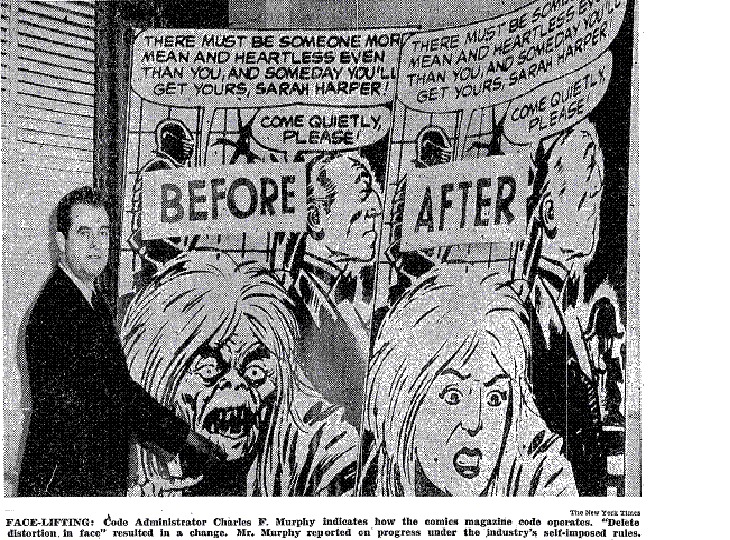
1950s backlash that resulted in the Comics Code mainly affected adventure
comics… in the 1960s, criticism was focused on the humor comics for being
violent, sexist, and racist. In the US, humor comics were similarly attacked,
and were additionally prone to criticism from the Left for being conveyors of
capitalist propaganda…” especially of the Disney titles (ex. Uncle Scrooge)
[3].
As one of the leading comic companies of the 50’s, EC Comics (short for “Entertaining Comics”) went near-bankrupt (if not for their MAD comic-turned-magazine), the comic market became available for other publishers to fall in place, and thus was done so by DC Comics and Marvel (previously known as ‘Atlas’ and ‘Timely’), and smaller companies, like Gilberton. At the same time, as horror and crime comics were pushed down and out of the magazine stands, the adventure story and romance tales were pushed into the forefront [3].
Various genres took over the spotlight as media venues were constantly grabbing for any content that would stick. Although this was met with a multitude of new content, not all content was seen as high quality. As described by Blackbeard, “By the 1960s, the newspapers’ need for quantity of strips had triumphed almost entirely over any series interest in quality of storyline or art.”
ROMANCE
“Crime
was going out. Sex was in” said Morisi. Although crime titles were still being
published, “many had disappeared since 1948”. “Meanwhile, romance was blooming
in the stands.” Crime publishers switched to romance titles, recognizing an
“appeal of comic books across gender lines [5].”

According
to Hajdu, “The first comic book devoted to love stories, Crestwood’s Young Romance, had not appeared until
the summer of 1947… In 1948, there were only three new love titles: Sweethearts, My Romance, and My Life,” creating a slow start for the
genre. However, “by the end of 1949, there were some 125 romance comics, and, a
year later, 148 from 26 publishers [5].” Romance may not have been
new to the stands by the 1960s, but by then the titles had exploded with
interest and popularity.
Part of
the reason romance titles became so popular was that they were adapted to
approach another new audience: adolescents. With older teenage characters,
romance stories attempted to reach their like-minded readers. For comics, this
would be a new, conscious attempt for an older audience than previously
generated [5].
Social
politics also held as a topic in romance titles, with stories of
“free-spirited, willful girls who thought and acted independently, challenging
not only their parents, but their boyfriends,” romances provided a unique model
placement in a young woman’s eyes. Being
most probably the only venue of young womanly independence at the time, “no
other genre of comic books was as overt in its depiction of youthful rebellion
as romance comics [5]. “
ADVENTURE
Although
it usually required a greater sense of artistic detail, the adventure genre is
said be one of the (if not the) most
diversely flexible comic genres. It is
probably this flexibility which has allowed the adventure genre to uphold its longevity
and resiliency in the post-Comic Code era. It was not long until sub-genres
took hold, including war anthologies (briefly spoken about before) and sports [3].
IPC (International
Publishing Corporation) was an initial leader in the adventure genre just as
they had been early on in humor comics. However, the comic
industry shift in the 1960s brought in new comic company giants, Marvel and DC
comics. Marvel and DC worked within the Code with their Superhero comics.
Marvel’s continued success “had the effect of kick-starting the entire industry
back into life.” Superman and Batman became DC Comics’ main stars, but the
diverse crew allowed the Superhero genre to thrive until the end of the 60s [3].
THE INTELLECTUAL COMIC
Post-Code
years also brought about the intellectual comic, which covered an array of
subjects, from social topics to physiological, and would include subjects not
yet portrayed in American comic strips. From the late 50s through the 1960s,
the intellectual comic would continue to grasp a greater hold of the reader’s
world, even incorporating politics.
Illustrative
“stereotypes of blacks as criminals and ‘social problems’ were common” within
comics throughout the 1950s and 1960s, and derogatory representatives rampant. “Arabs
were ‘shifty’, conniving and treacherous; Orientals were ‘inscrutable’ sadists;
and Native Americans were monosyllabic savages.” As one could expect, “both in
Britain and America, there were only a handful of creators from ethnic
backgrounds working in the industry” creating an obvious imbalance of insight in
the comics released [3].
“Sexism was seen as an even bigger problem…” and
was dealt with much quicker. Women were
usually only portrayed in three different ways; as ‘helpers’ (nurses,
housewives), ‘victims’ (to be rescued), or sex objects (plunging necklines and
long legs). In response to this, “Wonder
Woman was revolutionary in a psychological sense” and served as a
self-imposed high-calling to all women that they should “realize their
potential, should fight for equal rights, and that a feminized society would be
more caring than the prevailing patriarchy [3].”

Walt
Kelly’s beloved strip, POGO, made its
debut in 1949. Through Albert the alligator and his cast of animal characters,
he “was the first to deal with the great moral, social, and political
questions” within the lines of a comic. The characters at times fall under a
political sphere of conversation, and are each endowed with their own “highly
individual personalities.” It is this beginning which Couperie points out as “contributing
to the rehabilitation of the comic strip [1].”
Perhaps Kelly’s
intellectual “kindred spirit”, Charles Schulz arrived on the scene soon
afterwards in 1950. Schulz continued Kelly’s portrayal of intellectual comics
by “penetrated still deeper into intellectual analysis with his Peanuts”. Between the both
of them, “Schultz and Kelly endowed the comics with their patent of nobility,
and assured the birth and development of the intellectual comic strip [1].”
The
1950s intellectual comic brought about the first antihero by Bernard Mergendeiler,
Feiffer comic strip (“anti-comic
strip”) in 1956, dubbed the “blackest and most depressing ever depicted by the
comic strip.” and B.C. in 1958. They
continued in the 1960s with the Wizard of
Id. Other
intellectual comics of the time included The
Strange World of Mr. Mum by Irving Phillips, Short Ribs by Frank O’Neal, and Still
Life by Jerry Robinson, which portrayed only inanimate objects [1].
These
‘intellectual strips’ “present a remarkable esthetic unity. Their creators’
affinities lie not with the easy models of the novel and the cinema, but with
the most exacting of all methods of artistic expression: the theatre... the
characters are presented in full view, at eye level... and the only space we
are permitted to see is that defined within the rectangle of the picture… [1]”
UNDERGROUND
 Perhaps
the biggest dynamic of comics that wasn’t regulated by the Comic Code (and rather,
was inspired by its effects), was the underground movement established within
the United States. As San Francisco attracted musicians in the 1960s, it also
intrigued some artists in a new “comix” movement, influenced by MAD, “the
hippie generation”, and other surrounding culture developments [4].
Perhaps
the biggest dynamic of comics that wasn’t regulated by the Comic Code (and rather,
was inspired by its effects), was the underground movement established within
the United States. As San Francisco attracted musicians in the 1960s, it also
intrigued some artists in a new “comix” movement, influenced by MAD, “the
hippie generation”, and other surrounding culture developments [4].
Many
aspiring artists and writers founded and sought out University humor magazines
and other unorthodox publishing means in order to publish their own works. According
to Garcia, the comic Help! is seen as
the first underground comic book due to the various artists who worked on the
project. As the decade continued, various titles, including Zap and Wonder Wart-Hog, the pig parody of superhero comics [4].
NEXT TIME ON A
SCROLL IN TIME…
Although
the Comic Code changed the comic world forever, the medium itself showed to be
more resilient and transformative as some may have earlier predicted. The devastation
of the 50s and resurrection of the 60s within the comic domain was, although
crude, perhaps necessary to prepare it for the development and progressive period
of the 1970s, as American society was soon to see...
CATCH UP WITH ME IN THE
NEXT INSTALLMENT!
[1]
Couperie, Pierre, Maurice Horn, Proto Destefanis, EdouardFrançois, Claude
Moliterni, GéraldGassiot-Talabot, and Eileen Hennessy. A History of the
Comic Strip. New York: Crown, 1968. Print.
[2] Steranko, James. The Steranko History of Comics. Reading, PA. 1970. Print.
[3] Sabin, Roger. Comics, Comix & Graphic Novels. Hong Kong. 1996. Print.
[4] Garcia, Santiago. On the Graphic Novel. University Press of Mississippi. 2015. Print.
[5] Hajdu, David. The Ten-Cent Plague: The Great Comic-Book Scare and How It Changed America. New York. 2008. Print.
[2] Steranko, James. The Steranko History of Comics. Reading, PA. 1970. Print.
[3] Sabin, Roger. Comics, Comix & Graphic Novels. Hong Kong. 1996. Print.
[4] Garcia, Santiago. On the Graphic Novel. University Press of Mississippi. 2015. Print.
[5] Hajdu, David. The Ten-Cent Plague: The Great Comic-Book Scare and How It Changed America. New York. 2008. Print.


