Showing posts with label Art. Show all posts

Saturday, September 2, 2017

A Brief History in American Comics: Part 6- The Comic Rebirth of the 1960s


“The 1950s backlash that resulted in the Comics Code mainly affected adventure comics… in the 1960s, criticism was focused on the humor comics for being violent, sexist, and racist. In the US, humor comics were similarly attacked, and were additionally prone to criticism from the Left for being conveyors of capitalist propaganda…” especially of the Disney titles (ex. Uncle Scrooge) [3]

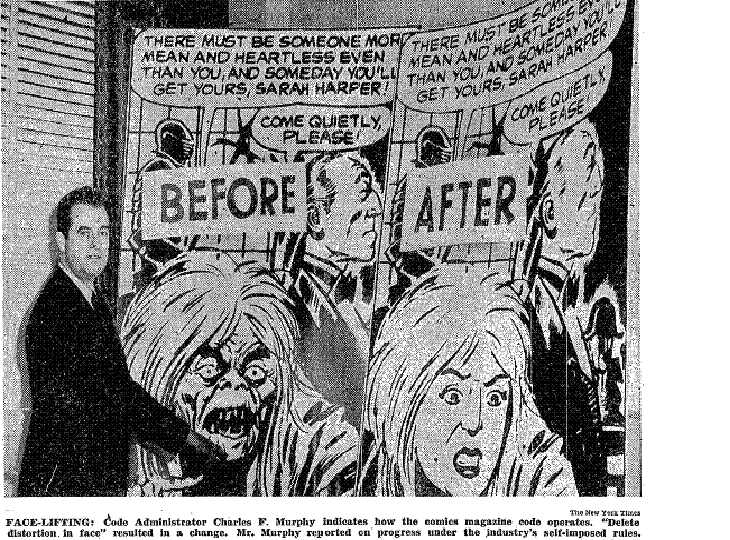
As soon as the Comic Code was implemented, the world of comics transformed. Sales slumped almost immediately as lines of comics were cancelled. Whole genres virtually destroyed, and entire publishing companies sunk.  “For parents and educators, the Code meant peace of mind, but for kids, it signified little except insipidly ‘safe’ entertainment [3].”

As one of the leading comic companies of the 50’s, EC Comics (short for “Entertaining Comics”) went near-bankrupt (if not for their MAD comic-turned-magazine), the comic market became available for other publishers to fall in place, and thus was done so by DC Comics and Marvel (previously known as ‘Atlas’ and ‘Timely’), and smaller companies, like Gilberton. At the same time, as horror and crime comics were pushed down and out of the magazine stands, the adventure story and romance tales were pushed into the forefront [3].

Various genres took over the spotlight as media venues were constantly grabbing for any content that would stick.  Although this was met with a multitude of new content, not all content was seen as high quality. As described by Blackbeard, “By the 1960s, the newspapers’ need for quantity of strips had triumphed almost entirely over any series interest in quality of storyline or art.” 

ROMANCE
“Crime was going out. Sex was in” said Morisi. Although crime titles were still being published, “many had disappeared since 1948”. “Meanwhile, romance was blooming in the stands.” Crime publishers switched to romance titles, recognizing an “appeal of comic books across gender lines [5].” 

According to Hajdu, “The first comic book devoted to love stories, Crestwood’s Young Romance, had not appeared until the summer of 1947… In 1948, there were only three new love titles: Sweethearts, My Romance, and My Life,” creating a slow start for the genre. However, “by the end of 1949, there were some 125 romance comics, and, a year later, 148 from 26 publishers [5].” Romance may not have been new to the stands by the 1960s, but by then the titles had exploded with interest and popularity. 

Part of the reason romance titles became so popular was that they were adapted to approach another new audience: adolescents. With older teenage characters, romance stories attempted to reach their like-minded readers. For comics, this would be a new, conscious attempt for an older audience than previously generated [5]. 
 Social politics also held as a topic in romance titles, with stories of “free-spirited, willful girls who thought and acted independently, challenging not only their parents, but their boyfriends,” romances provided a unique model placement in a young woman’s eyes.  Being most probably the only venue of young womanly independence at the time, “no other genre of comic books was as overt in its depiction of youthful rebellion as romance comics [5]. “

ADVENTURE
Although it usually required a greater sense of artistic detail, the adventure genre is said be one of the (if not the) most diversely flexible comic genres.  It is probably this flexibility which has allowed the adventure genre to uphold its longevity and resiliency in the post-Comic Code era. It was not long until sub-genres took hold, including war anthologies (briefly spoken about before) and sports [3]. 

IPC (International Publishing Corporation) was an initial leader in the adventure genre just as they had been early on in humor comics. However, the comic industry shift in the 1960s brought in new comic company giants, Marvel and DC comics. Marvel and DC worked within the Code with their Superhero comics. Marvel’s continued success “had the effect of kick-starting the entire industry back into life.” Superman and Batman became DC Comics’ main stars, but the diverse crew allowed the Superhero genre to thrive until the end of the 60s [3].

THE INTELLECTUAL COMIC
Post-Code years also brought about the intellectual comic, which covered an array of subjects, from social topics to physiological, and would include subjects not yet portrayed in American comic strips. From the late 50s through the 1960s, the intellectual comic would continue to grasp a greater hold of the reader’s world, even incorporating politics. 

Illustrative “stereotypes of blacks as criminals and ‘social problems’ were common” within comics throughout the 1950s and 1960s, and derogatory representatives rampant. “Arabs were ‘shifty’, conniving and treacherous; Orientals were ‘inscrutable’ sadists; and Native Americans were monosyllabic savages.” As one could expect, “both in Britain and America, there were only a handful of creators from ethnic backgrounds working in the industry” creating an obvious imbalance of insight in the comics released [3].  

 “Sexism was seen as an even bigger problem…” and was dealt with much quicker.  Women were usually only portrayed in three different ways; as ‘helpers’ (nurses, housewives), ‘victims’ (to be rescued), or sex objects (plunging necklines and long legs). In response to this, “Wonder Woman was revolutionary in a psychological sense” and served as a self-imposed high-calling to all women that they should “realize their potential, should fight for equal rights, and that a feminized society would be more caring than the prevailing patriarchy [3].” 

Walt Kelly’s beloved strip, POGO, made its debut in 1949. Through Albert the alligator and his cast of animal characters, he “was the first to deal with the great moral, social, and political questions” within the lines of a comic. The characters at times fall under a political sphere of conversation, and are each endowed with their own “highly individual personalities.” It is this beginning which Couperie points out as “contributing to the rehabilitation of the comic strip [1].” 

Perhaps Kelly’s intellectual “kindred spirit”, Charles Schulz arrived on the scene soon afterwards in 1950. Schulz continued Kelly’s portrayal of intellectual comics by “penetrated still deeper into intellectual analysis with his Peanuts”. Between the both of them, “Schultz and Kelly endowed the comics with their patent of nobility, and assured the birth and development of the intellectual comic strip [1].” 

The 1950s intellectual comic brought about the first antihero by Bernard Mergendeiler, Feiffer comic strip (“anti-comic strip”) in 1956, dubbed the “blackest and most depressing ever depicted by the comic strip.” and B.C. in 1958. They continued in the 1960s with the Wizard of Id. Other intellectual comics of the time included The Strange World of Mr. Mum by Irving Phillips, Short Ribs by Frank O’Neal, and Still Life by Jerry Robinson, which portrayed only inanimate objects [1]. 

These ‘intellectual strips’ “present a remarkable esthetic unity. Their creators’ affinities lie not with the easy models of the novel and the cinema, but with the most exacting of all methods of artistic expression: the theatre... the characters are presented in full view, at eye level... and the only space we are permitted to see is that defined within the rectangle of the picture… [1]

UNDERGROUND
Perhaps the biggest dynamic of comics that wasn’t regulated by the Comic Code (and rather, was inspired by its effects), was the underground movement established within the United States. As San Francisco attracted musicians in the 1960s, it also intrigued some artists in a new “comix” movement, influenced by MAD, “the hippie generation”, and other surrounding culture developments [4]. 

Many aspiring artists and writers founded and sought out University humor magazines and other unorthodox publishing means in order to publish their own works. According to Garcia, the comic Help! is seen as the first underground comic book due to the various artists who worked on the project. As the decade continued, various titles, including Zap and Wonder Wart-Hog, the pig parody of superhero comics [4].
 

NEXT TIME ON A SCROLL IN TIME…
Although the Comic Code changed the comic world forever, the medium itself showed to be more resilient and transformative as some may have earlier predicted. The devastation of the 50s and resurrection of the 60s within the comic domain was, although crude, perhaps necessary to prepare it for the development and progressive period of the 1970s, as American society was soon to see...

CATCH UP WITH ME IN THE NEXT INSTALLMENT!


[1] Couperie, Pierre, Maurice Horn, Proto Destefanis, EdouardFrançois, Claude Moliterni, GéraldGassiot-Talabot, and Eileen Hennessy. A History of the Comic Strip. New York: Crown, 1968. Print.
[2] Steranko, James. The Steranko History of Comics. Reading, PA. 1970. Print.
[3] Sabin, Roger. Comics, Comix & Graphic Novels. Hong Kong. 1996. Print.
[4] Garcia, Santiago. On the Graphic Novel. University Press of Mississippi. 2015. Print.
[5] Hajdu, David. The Ten-Cent Plague: The Great Comic-Book Scare and How It Changed America. New York. 2008. Print.

Saturday, July 15, 2017

A Brief History in American Comics: Part 5- Critique and Dark Days of the 1950s


Threatened with artistic sterility, and imprisoned within its own clichés, the American comic strip faced a new and grave danger,” according to Couperie.
Comics made headlines “Since their creation, the [American] comics had been the object of numerous attacks…” but yet nothing to this stature.

The Anti-Comics Movement: Early 1900s
In the earliest part of the 1900s, characters like Yellow Kid and the Katzenjammer Kids were labeled as glorified “anarchistic rascals” and called “a waste of time” by critiques. Comics as a medium has always held many critics, despite (and due to) its growing popularity. At one point, these critiques even led to the Boston Herald abandoning its illustrated Sunday supplement in 1908, although it was quickly re-added due to its great loss in subscribers [1]. 

In 1917, the Vatican ruled that he and some bishops could ban books and works which were deemed too obscene or containing non-Catholic issues. Inspired by this, in the early 1930s, Bishop John Noll established a regional League for Clean Reading or LCR.  In 1938, Noll brought his crusade “to a national stage” with the National Organization for Decent Literature, or NODT, a variation of the LCR. NODT became official in 1939, and held as a Christian-led effort nationwide [5].

The general repulsion of comics wasn’t new, even in the 20th century, and is in fact supported by various social elements, as told by Sabin: “stories in pictures were maintained to be innately inferior to those in words, and it was now argued that children’s ability to learn to read would be retarded by an over-familiarity with comics. This view was supposedly corroborated by the fact that strips now contained fewer words than ever before (at least the old complained that close type strained the readers’ eyesight was no longer tenable). The pre-1914 prejudice against comics for being ‘reading matter for the working class’ held fast. Especially in the case of children, it was maintained that comics were not ‘improving’, were essentially ‘lowbrow’, and reflected badly on the reader’s background and intellect [3] .

The presence of comics in public did not exemplify immediate vigor. In fact, “the public, at best, merely tolerated this type of literature.” It was often seen as “tasteless” or labeled as “trash” by many. In 1936, a Connecticut school teacher commented that dime novels “constitute a menace to pupil’s morals, English and mind [2].”

1940s – 1950s
In the mid-1940s, juvenile delinquency gained significant notice in public news and neighborhoods. Many thought that comics “not only depicted but incited youthful impropriety [5].”

“Within a year of Pearl Harbor, the American press was probing the effect of the war on home-front families… In the years to follow, there were dozens of prominent stories about young men from fatherless households, roaming the streets in lawless packs, and young women who had absentee working mothers, dropping their morals [5].” There were of course, several factors that could have helped cause these changes at home, but the one causation that media latched onto was comics.
Articles such as Robert E. Southard’s “Parents Must Control the Comics” in 1944 described superheroes as articles of fascism and “un-American.” Rev. Thomas F. Doyle’s “What’s Wrong with the ‘Comics’?” in 1943, described superheroes as “false cartoon gods” and asked his readers, “if young people inclined to antisocial behavior were to ‘get ideas’ from comics, ‘what is to prevent them from getting ideas of hijacking, smuggling, gang fighting, train wrecking, robbery, racketeering, and murder [5]?’”

Several writers began coming out of the woodworks, accusing comics of “sowing disrespect and insubordination in the minds of children.” Comic strips were seen as the cause of “undermining the morals of youth” by “psychologists, pedagogues, and demagogues of all political colors mounted an all-out assault against it” And hit the height of criticism in the 1950’s [1].

The Social Importance, and Thus Problem, of Comics
Despite their trouble, comics were seen as a part of ‘childhood’. As such, while “they may have had their faults, the thinking went, but, after all, they were a part of a… special time in life: a time symbolic of a state of innocence… A romanticism legacy from the Victorian Era, where Children were sentimentally angelic creatures to be protected from the temptations of the world… It was important that juveniles should not encounter any semblance of the adult world (any hint of sex, realistic violence or adult relationships would have shattered the illusion) [3].”

“Confusingly, then, comics were sentimentalized on hand, and criticized on the other… they still were not ‘respectable’… teachers felt perfectly at liberty to confiscate them in schools, and parents to ban them from the home. Yet because they were not oriented towards a juvenile market, they were also ‘winked at’ and tolerated. It was an odd set of contradictions, and one which children’s comics never quite escaped until the present [3]."

The Comic Book Siege
“If the newspaper strips had had trouble gaining the respect of society, comic books lowered even further society’s view of comics. The comic book was, clearly and without argument following the triumph of the superheroes, a medium aimed at children, and one that did not appear to be particularly beneficial or to possess any redeeming quality in the eyes of parents and educators. If for many people comics in and of themselves were bad, comic books were bad comics [4].”

 “Even though comic books were in fact read by many adults, this was not something acknowledged without some embarrassment. Gerard Jones observes that ‘when the press wanted to paint the murderous gangster Dukey Maffetore as mentally subnormal, they had only to report that he read Superman comics.’ This, despite the fact that a 1950 survey produced some surprising data, including that 54% percent of all comic books were read by adults over 20 years old, and that the average adult read some eleven comics per month [4].”

Public Burnings and Legal Action
After numerous instances of media claiming activities from thievery to deaths on the comics the perpetrators typically read, the first city to “crack down” on comic books was Detroit in 1948. Based on material presented to the Commissioner and other law-enforcement agents, 36 comics were justified as “objectionable material” and therefore seized and banned from newspaper stands. Less than two weeks after the events in Detroit, on May 10th, the acting police chief of Ann Arbor announced the outlawing of 30 comic books due to their violation of the state’s law “prohibiting the sale of publications portraying ‘crime, bloodshed, and indecency.’” Only four days later, Mt. Prospect, Illinois forbade “the display or the sale of any comic book, regardless of its content [5].”

By the end of May, at least two more locations had passed acts “to curtail the sale of comics.” Still some others were in process of developing their own. “In the months to follow, more than fifty municipalities, including several of the most populous in the United States, would develop initiatives to curb the sale of comic books.” Due to law generalizations, many comic book titles fell subject to new and old legislation which forbid “immoral” or “indecent” mail, publications, or other types of media, leaving the evaluation to the eye of the beholder. Even the Supreme Court had objections to these books, as we may explore at another time [5].

Various schools, including Catholic and other religious schools, also staged book burnings, making it a fairly common occurrence. Depending on the event, students were encouraged to either bring in all comic books, or at least all of “offensive” or “indecent” materials” to school, where fire pits would be arranged to reduce all books presented to ash. Most students, convinced of their plague by their teachers, complied. Still others, either not quite convinced of their harm or still drawn to their stories and content, hid or kept at least some books away at home [5].

By 1950, the comic siege among the media had taken hold, and comic book publishers had toned down much of their content, specifically crime titles. Some, such as Victor Fox, began labeling their comics as “Not Intended for Children” or “For Adults Only” in attempt to set themselves apart from ‘childish content’ (which no one really believed). However, alongside with crime titles toning down, publishers had found a new genre to introduce: horror [5].

Towards the end of 1953, comic books criticism was rising to its peak. “Nobody was writing anything about [comic books] except to say how terrible they were” according to a recount by Will Eisner, “I felt that nobody was paying attention, except the readers, and they were mostly kids, so nobody took them seriously.”The communism threat also began to take hold on the United States, with comic book publishers looked at like, or called, Communists [5].

Comics reach The Innocent
In 1954, this “assault” culminated with psychiatrist Dr. Frederic Wertham’s The Seduction of the Innocent. While providing careful examples, sketches, and “sometimes actual falsifications”, Dr. Wertham convinced numerous parents and community leaders of every sort that comics were to blame for “encouraging all the sins and vices of the earth” and were “the source of all our problems [1].”

The book’s “opening words[5].
… describe the book as ‘the result of seven years of scientific investigation conducted by” the author himself, who “has had long experience in technical research” and “thoroughly documented by facts and cases

Wertham concluded that all comic books, regardless of genre or form, were “harmful to the development of young minds” and mostly raked them all in with “crime comics” because “all of them, in his view, portrayed some violation of legal, moral, or religious codes… they were vulgar, ungrammatical, poorly drawn, and chilly printed, stunting children’s intellectual growth and bad for children’s eyes, recapitulations of the turn-of-the-century criticism of newspaper funnies [5].”
Superhero comics were treated no different, and specifically the three most popular heroes, Batman, Superman, and Wonder Woman, were labeled as fascist, homoerotic, and sadomasochistic, respectively [5].

Although other studies refuted Dr. Wertham’s findings, the impressions he had left on mothers and many others could not be reversed. Cartoonists were almost immediately met with censorship by syndicates [1] and even banning in some American towns and cities [5].  Several, understandably, felt they clearly saw the age of comics as a whole coming to a brutal end. Artists like Burne Hogarth abandoned the comic strip entirely, while still others “were content to serve up to their readers an inoffensive gruel [1].”

In April of that year, two days of Senate hearings on comic books were held, ran by Robert C. Hendrickson. These hearings, which came to be known as the Hendrickson committee hearings, was a televised and anticipated event which brought all previous thoughts of comic books to a head, both in the courtroom and in family living rooms. During the hearing, 24 full-color, enlarged copies of various comic book covers and images were used as evidence of the graphic and immoral depiction of violence, sexualization, and grotesque nature of comic books. Representatives from Crime Does Not Pay to Tales from the Crypt were scrutinized [5].

The first senate hearing was held on April 21, 1954 and was televised, creating havoc amongst parents and comic critics. The second hearing, held on June 4th, 1954, although not televised and “largely technical”, was focused on the selling and distribution practices of comics. These hearings are also known as the Kefauver committee hearings, after their co-sponsor, Estes Kefauver [5].

The Comic Industry’s Answer
Shortly after, inspired by the surrounding impending devastation in the industry, the call was set out to found the Comics Magazine Association of America. Initially devised of 38 publishers, distributors, printers, editors, and engravers in the industry, the CMAA held as replacement for the previous Association of Comics Magazine Publishers. One of the CMAA’s first orders of business was to establish a new code of conduct to be regulated and strictly followed by future-released comic books [5].

While not all comic companies were regulated by the CMAA’s Comic Code, parents took immediate notice of the small, rectangular seal on the cover of every “approved” comic, recognizing them as appropriate for child consumption [5]. Magazines like MAD and Panic! (as well as everything else by EC Comics) are examples as to those which were following, nor in regulation to, the Comic Code.
The After Effects.. What Happens Next?

 [1] Couperie, Pierre, Maurice Horn, Proto Destefanis, EdouardFrançois, Claude Moliterni, GéraldGassiot-Talabot, and Eileen Hennessy. A History of the Comic Strip. New York: Crown, 1968. Print.
[2] Steranko, James. The Steranko History of Comics.Reading, PA. 1970.Print.
[3] Sabin, Roger. Comics, Comix& Graphic Novels. Hong Kong. 1996. Print.
[4] Garcia, Santiago. On the Graphic Novel. University Press of Mississippi. 2015. Print.
[5] Hajdu, David. The Ten-Cent Plague: The Great Comic-Book Scare and How It Changed America. New York. 2008. Print.

Saturday, June 10, 2017

A Brief History of American Comics: Part 4- Post-War Comics

Newspaper Comics

The end of WWII “precipitated the decline of the American comic strip [3].”  After 1946, “humorous strips were no longer so amusing, the adventure strips seemed to have lost their spirit. It is understandable that after a conflict that had cost 30 million human lives, humorists found it a bit difficult to be funny”. Adventure strip heroes now seemed “contemptible, futile, and almost unseemly” compared to the actions of real-life soldiers and combatants [3].

For cartoonists and comic writers, the end of battle meant bringing home the nation’s most famous war heroes. As discussed previously, many readers “tuned in” to comic pages to root on Superman, Joe B, and others in their fight against Nazis and the Japanese. Now that these fights were no longer relevant, what would writers bring to the table? What new spectacles could possibly best the latest real-life adventures [3]?


Ironically, it was about this time that “true” stories are exactly what became relevant to the times. However, instead of evolving from the adventure strip, more genres awoke from the staleness in the comic stands. By the mid-1950s, detective, romance, and horror comics would each take root and grow in their own rights, each with their own paths.

Although few creators found success when deviating from the tried-and-true methods, (their audience merely seeking a mental escape rather than unfamiliar territory), their attempts did generate interest in cartoonists to opening the adventure genre to wider possibilities [3].

Titles like Kerry Drake, Rip Kirby, Steve Roper (continuation of pre-war series, Big Chief Wahoo) exemplified the crime-action genre. As all were “strong and effective strip narrations, they each did well to hold captive audiences. A comic strip version of Mickey Spillane’s Mike Hammer “proved to be a genuinely gutsy reflection of the long-lasting novel series and way too tough for the majority of newspapers [1].” In this way, it stood apart from most other strips out there.

Specifically, post-war military adventure stories became “a genre all its own”. Strips like Terry and the Pirates and Captain Easy were abandoned by authors to pursue serials more generated towards Air Force and Navy-topics/interests, like Steve Canyon and Buz Sawyer, respectively [1]. 

Sci-fi (then called pseudo-science) also became a popular topic, which became “very well served’ with strips like Space Cadet, Twin Earths, Flash Gordon, Planeteer, and even time-traveling adventures like Alley Oop and Beyond Mars. Eventually even sci-fi serials would develop the common problem of needing more and more content to stay relevant and to merely continue the story-line. These same needs were what would cause them to be “eventually strangled by the same space limitations that brought all serious continuity strips to their finish or a lingering impotence.” Outside of the action and sci-fi type stories, comedy also flourished again during the 1950s. Pogo and Peanuts made their comic strip debuts during this time-frame [1].

Pogo was an unusual example between the two mediums, as a character who transitioned from comic books to newspapers. Pogo first appeared in comic books through Animal Comics (1941) and Pogo Comics (1946). However, he would develop its international audience once incorporating politics in its own newspaper strip, acting as “defenders of civil rights and the environment, and opponents of censorship [5].”

Comic Books
Meanwhile, comic books continued to pick up steam with the development of their own audience, namely comics generated towards children and teenagers.  Children comics came lightly early in the decade, through Disney (1940), Looney Tunes (1941), and Bugs Bunny (1942).  In the 1950s, “kid comics” hit widely, with various titles like Little Audrey (1952), Little Dot (1955), Little Lotta (1955), and Richie Rich (1960). Children comics also dabbed into the sci-fi and supernatural with Casper (1955), and Wendy the Good Witch (1960) [5].

Teenager comics were still a bit of a novelty around the 1940s, as “adolescents had only recently been discovered to be a separate tribe”. Still, with Archie (1942) hitting its chart-topping popularity, imitating titles like Andy (1948), Ernie (1948), and Dudly (1949) allowed teen titles to pick up steam. The 1950s took this genre and ran, looking more like comedic and oddity comics we might recognize today. With MAD meeting with great sales when it was published in 1952, several more, entitled things like Crazy (1953), Wild (1954), and Help! (1960) followed suit [5].


In the 1930s, pulp magazines flooded the stands, with titles like The Ghost Super Detective, Captain Satan, King of Detectives, and Secret Agent X. They continued through the 1940s and 50s with several more denoting detectives, mysteries, and the supernatural. With titles/topics like these, it was clear that if comic demographics weren’t changing, its content was [4]. These new materials opened comics and other graphic materials to a larger, more mature scope of content, which at once created a larger audience base and a higher rate of critique backlash.

Pulps became popular with tales of adventure, oddities, and other out worldly happenings. “Air-war magazines” became a topic with titles like Robert Jasper Hogan’s G-8 saga. Supernatural and oddities grew with stories inspired from HP Lovecraft stories and Weird Tales.  “Pseudo-science” genres (which predated the term ‘sci-fi’) covered topics from fantasy to space tales with Planet Stories and Captain Future: Wizard of Science. Horror tales also became popular with their graphic and dark-themed stories [4].

These new comic and pulp genres brought about its own growing pains in the comic world, with parents and various religious and community leaders continuously questioning the validity of what their youth were reading. Although not a new topic of conversation (as we will discuss further), the developing comic content (and other social changes) allowed these various outlets to boost their argument. As we will see in our upcoming segments, “Comics thus became a discussion topic in newspaper opinion columns and on radio chat shows: the question was, where they ‘a good thing’ or not [5]?”

Pulps and comic books, as most entertainment and art forms do, took influence from each other [4]. Pulps would continue to influence comic books for years. In fact, several staff (writers and illustrators) of DC and Marvel began their careers in pulps, either as writers or book cover illustrators. “Thus, the adventure comics developed a different aesthetic [5].”

The aesthetic wasn’t the only thing pulps and comic books shared. In 1934, a short run detective series called Black Bat Detective stayed a “mysterious detective” called the Black Bat. In 1939, the character known as The Black Bat appeared in Black Book Detective. Comic book star Batman also arrived in 1939, and attributed more than just the name and genre from his pulp magazine counterpart.  Batman wasn’t the first cross-media character (see our previous mention of Superman and Doc Savage), and certainly was not the last [4].

While pulps and comic books took plenty of suggestions from each other, the history of one seemed to diminish almost as soon as the other began. Pulp magazines, named after the recycled paper it was printed on, was literally built off of the ability to write and print as much as possible as cheaply as possible, granting it the nickname ‘dime novels’ [4]. Once comic books began hitting their popularity streak, both pulp publishers and readers saw the significance. Writers could “tell a story faster” with comic books, and readers were hit with “less intellectual drag”. As the decade continued, pulp magazines like Timely Comics and those from Fiction House practically began to transform into comic books. Despite the medium change, familiar characters could still be seen in alternate forms, being found “in paperbacks from time to time [4].”

Superhero comics “were essentially aimed at children, but derived from a pulp tradition, and thus often contained political and social overtones.” The “bold, figurative art with strong colors” (which pulp artists help bring to the medium) became iconically separate from the “abstract poetic fantasies that distinguished the more artsy newspaper strips.” Action comics also made their own impression on comics by being one of the genres that included cinematic qualities like close-ups, panoramas, and exciting ‘cuts’ [5]. These cinematic qualities helped change story-telling techniques and transform comics into its more updated or modern form.

Between the 1940s and 1960s, comic book stands would see several comic companies attempt great popularity, with many having to quit due to various reasons. The two major comic book companies around was DC & International Publication Corporation (IPC). These two became large enough that they did not receive much competition until the 1960s. Smaller companies were either unable to stay afloat or would become absorbed by either of the two larger names. Ironically, once competition did hit, the comic giants, then DC and Marvel, practically outshined all other comic company and businesses, “which corresponded with the overall decline in comic circulation [5].”


CASUALTY OF WAR- CAPTAIN AMERICA
“Captain America’s popularity varied in direct proportion to the intensity of the war.” When war events were high, Captain American flourished. When they looked poorly, so did he [4]. Finally, after the war was over, what was his life to be?

In 1944, Cap began his life of chasing crime, after “bizarre criminals who perpetrated strange crimes” and seemingly, running out of time. His costume, set for American patriotism rather than chasing criminals, according to Steranko: 

“In Issue 58, Steve Rogers had switched from army khakis to civilian clothes. By number 60, he had enigmatically became a teacher at Lee High School complete with briar pipe and school --- spectacles.”

Betsy Ross, Roger’s new love interest, was introduced in 1948. She was groomed as his assistant, Golden Girl [4].

Captain America’s Weird Tales took shelves in October 1949, in attempt to keep the hero relevant in recent sales. However, by the next issue, Red Skull had taken center stage and Cap was officially replaced, with “no other recognition or mention [4]. “

In the end, the majority of comic superheroes had reached the end of the line. They each served their time, but once the air had cleared and the war settled, their retirement was in sight. The few that did make it past the 1940’s, like their soldier counterparts, lived very different lives than what they had left behind. They had served their purpose but the world had to move on…

But what was that world to be? Time could only tell.


Next time on A Scroll in Time: Comics are about to take a drastic change! Next time, we take a look back throughout the decades to see the development in critique and hostility against American comics, which led to a massive shift in the censorship of comic books throughout the United States, ultimately changing how we know comics today!


[1] Marschall, Richard. America’s Great Comic-Strip Artists. New York, NY. 1989. Print.
[2] Blackbeard, Bill and Crain, Dale. The Comic Strip Century: Celebrating 100 Years of an American Art Form. Englewood Cliffs, NJ. 1995. Print.
[3] Couperie, Pierre, Maurice Horn, Proto Destefanis, Edouard François, Claude Moliterni, Gérald Gassiot-Talabot, and Eileen Hennessy. A History of the Comic Strip. New York: Crown, 1968. Print.
[4] Steranko, James. The Steranko History of Comics. Reading, PA. 1970. Print.
[5] Sabin, Roger. Comics, Comix & Graphic Novels. Hong Kong. 1996. Print.
[6] Garcia, Santiago. On the Graphic Novel. University Press of Mississippi. 2015. Print.